Monday, 3 May 2021

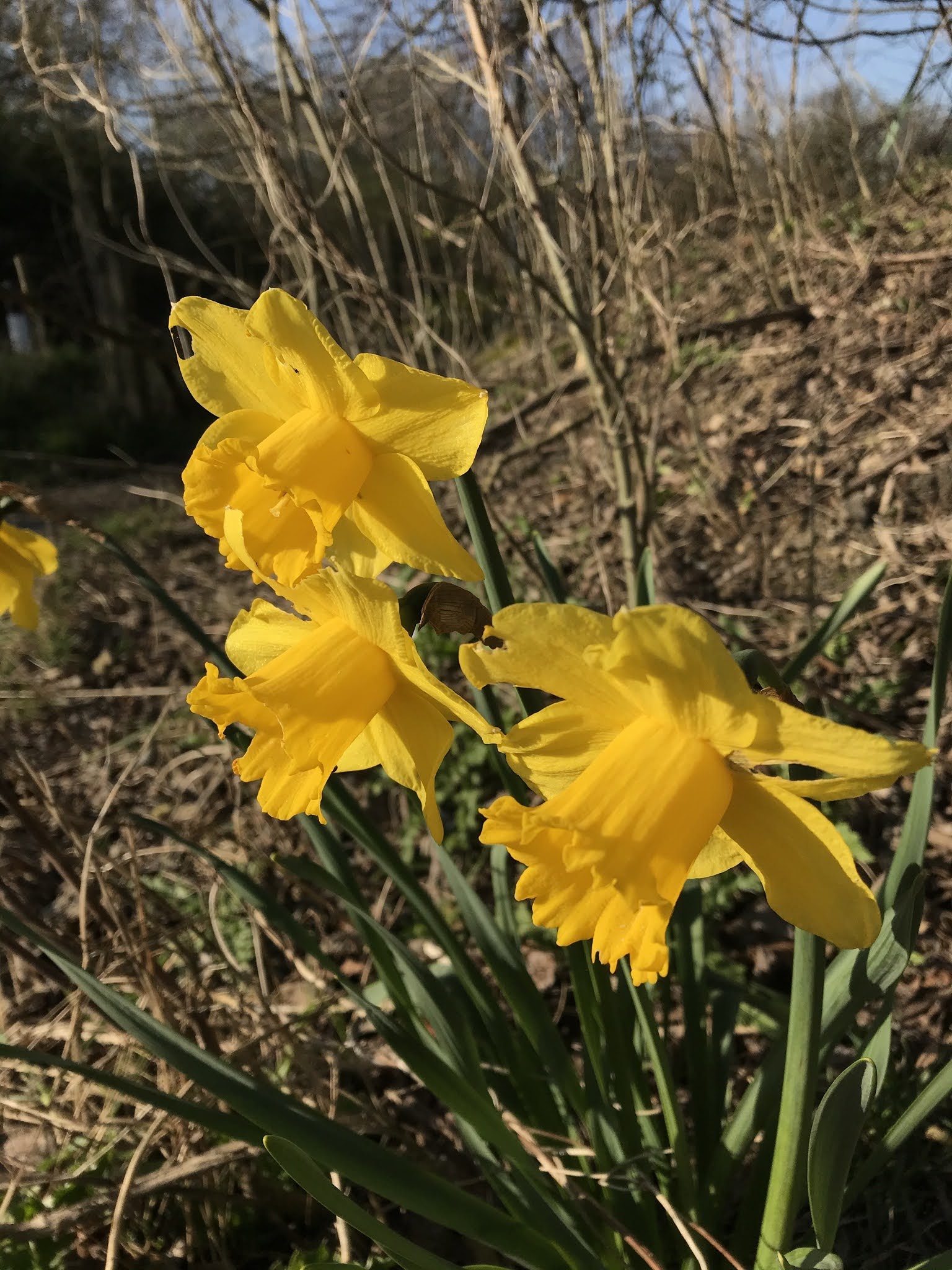
Daffodils

This is becoming an annual spring obsession now but its amazing how many you can clock up over the period March to May (none are in flower in February in Leeds, not even 'February Gold'). I only concern myself with those found in woods, on river banks, areas of waste ground, unmanaged churchyards and similar situations, deliberately steering clear of urban road verge plantings. Accordingly, I tend to find mainly the old tried and true cultivars that are tough as old boots, so largely pre-1940's or exceptionally pre-1970's. 'Oxford Gold' with a registration date of 2007 was a complete surprise this year, popping up in an obscure part of the churchyard after last years clearance of brambles.

Highlights from this years haul (with date of registration) include:

Actaea (<1919)                                            Aranjuez (1932)

                                                                                             Barrett Browning (1945)                           Bath's Flame (1913)


Beersheba (1923)                                        Dick Wilden (1962)

Carlton (1927)                                            Conspicuus (1869)


Delibes (1950)                                            Double Sir Watkin (1916)


Dutch Master (1948)                                   Emperor (1869)


Empress (1869)                                           Feu de Joie (1927)


Flower Drift (1966)                                    Flower Record (1943)


Fortissimo (1964)                                       Glenfarclas (1976)


Golden Harvest (1920)                               Gulliver (1927)


Ice Follies (1953)                                        Itzim (1982)


Jenny (1943)                                               Jetfire (1966)


Magnet (1931)                                            Maximus (1576)


Mount Hood (1938)                                    Oxford Gold (2007)


Pomona (1930)                                           Princeps (<1830)


Ptolemy (1921)                                           Sempre Avanti (1938)


Sir Watkin (<1868)                                     Spellbinder (1944)


Stella (<1869)                                             Sulphur Star (<1869)


White Lady (<1897)                                   White Lion (<1949)


Sunday, 18 April 2021

Alpine Cotula Expands its Range

Bruce Brown has been busy over the last few months processing an exceptional number of records collected by the Wharfedale Naturalist's in 2020, a very large number of which are directly attributable to Bruce and Carmen Horner. I have only just started to look in detail at what they found, but one record that immediately jumped out as interesting was a new location for Alpine Cotula (Cotula alpina).

Photo by G. Richards, Assynt Field Club website

Alpine Cotula is a native of Australia and was added to the British List as recently as 2009. It shows a strong affinity with grouse moors and is widely established in the North York Moors, and the moors of Nidderdale to the north of Pateley Bridge. Linda Robinson provides an account of the discovery of this species here, and further images can be found here.

Bruce and Carmen have now extended this species distribution to the grouse moors of Wharfedale, having found it August 2020 on Burley Moor (VC64). Time will tell how established it is in that area, one to look out for as it is probably more widely established.

Monday, 5 April 2021

Hedera algeriensis 'Ravensholst'

A trip over to Temple Newsam (VC64) yesterday for a bit of daffodil spotting (beats dandelions for me at this time of year!) gave an opportunity to check back in with this ivy in North Plantation, where a large stand has established across the woodland floor and climbing trees.

This has to be the most impressive of the naturalised ivies, the leaves are absolutely enormous. But this does leave it a little vulnerable to our up and down climate. The last time I saw it a couple of years back it had been badly hit by a late frost. But this year it was in perfect condition.

Algerian Ivy (Hedera algeriensis), usually in its smaller leaved forms, is not uncommon as a garden escape but possibly remains overlooked. Perhaps in some cases it is passed over as 'Irish Ivy' (Hedera hibernica 'Hibernica'). The variegated 'Gloire de Marengo' is particularly frequent. 

Saturday, 27 March 2021

Muscari botryoides

Compact Grape-hyacinth (Muscari botryoides) looking fab in Oulton churchyard (VC63) today. One of the less common grape-hyacinth species. Note the distinctive broad leaves. 


Sunday, 21 March 2021

Bleurgh

It had to happen sooner or later, but today was the day that I found a split corona daffodil (Narcissus agg.) in a wild setting. My feigned disgust is a little tongue in cheek as on its own merits its a brightly coloured and quirky flower, but lets be honest its not really what anyone wants from a daffodil.


This cultivar seems to be 'Cassata' which starts off bright yellow and then fades. I had always assumed this type of daffodil was a recent development. But the invaluable DaffSeek website states that it is a relatively old cultivar that was registered in 1963.


Sunday, 7 February 2021

More Ivies

The peak of the snowdrops is perhaps still two weeks off in my part of Yorkshire, meaning there is still not much of interest in local woods and hedge banks as we hit 'mud month' (that really is an old and very apt name for February). Thankfully, there is a little colour around here and there in the form of escaped cultivars of Common Ivy (Hedera helix).

Two golden forms caught my eye today as I slopped around Woodlesford (VC63).

'Goldchild' is a distinctive form with moderately large (for H. helix) thin leaves. It is a relatively modern cultivar coming into cultivation from the 1970's,


Not too far away was this smaller, glossier and more leathery leaved form. In comparison with the above, the gold patterning is much less extensive than the patches of green and grey-green. This seems to be 'Tricolor' which is a very old cultivar that originates before 1865. I can see why it has remained popular for so long. It is meant to develop a pink edge to the leaf in autumn but this is not apparent here.