Showing posts with label Leeds. Show all posts

Tuesday, 19 July 2022

Knapweed Novelties

Shortly after completion of construction of the A1(M) east of Leeds in 1999, the verges and road junctions in the vicinity of Aberford and Hook Moor (VC64) became briefly notable for unusual flora. Most especially, for the knapweeds that established from the seed mixtures used to 'restore' the affected landscape. Chief amongst these was Panicled Knapweed (Centaurea rhenana), a delicate airy species from mainland Europe. Its had a name change since then and now goes by Centaurea stoebe subsp. stoebe. It only really came onto my radar when Mike Wilcox re-found it in 2019, a remarkable 20 year persistence for a species still not listed in Stace or any other British Flora. 

So finally, I made a conscious decision this weekend to pick an area of promising habitat near the motorway to see if I could find it. And I did. What was even better was that the location I chose to search is a new one. The plot has also recently thickened with Mike advising me that the true identity was likely to be a related subspecies that is widely known as an invasive species in Europe and North America. This is Spotted Knapweed (Centaurea stoebe subsp. micranthos), a species it runs down to nicely in a key I found online.


The verges of the A1(M) between Garforth and Aberford are also a dependable hunting ground for Brown Knapweed (Centaurea jacea), although it is vastly outnumbered by its hybrid with the native Slender Knapweed (Centaurea debeauxii subsp. nemoralis) i.e. Centaurea x monktonii. Based on the situation in West Yorkshire, this hybrid must be widely overlooked elsewhere within the core range of Slender Knapweed. One to look for in modified landscapes where knapweeds have been introduced in the past.

More unexpected after the above was a robust knapweed well off flowering but with well developed buds with feathery recurved phyllaries. This seems to be Centaurea oxylepis, which will have also derived from the original sowing some over 20 years ago.

The final good find was two new locations for an alien Greater Knapweed first found by Mike to the north of Aberford in 2021, which we came to the decision (based on limited online sources) was a good match for Centaurea scabiosa subsp. alpestris. This is a striking species with, when compared with the native subsp. scabiosa, very variably dissected yellow-green leaves, and larger capitula with a much more prominent (but variable, even on the same plant) black apex to the phyllaries.


Sunday, 18 October 2020

Atlantic Ivy - Overlooked as a Garden Escape?

Atlantic Ivy (Hedera hibernica) is the dominant ivy along the western fringes of Britain, while further east and inland it is generally considered to be replaced by Common Ivy (Hedera helix).  The very robust cultivar 'Hibernica' (also known as 'Irish Ivy') being the exception to this, having been widely planted historically and subsequently has spread widely in suburban areas, railway banks and woodland. Despite this it still seems to be under-recorded. In part this is because in some counties it isn't recorded to cultivar level, instead being lumped under Atlantic Ivy. However, there do seem to be some genuine large gaps that are inconsistent with its ubiquity elsewhere. The BSBI database still lists it and maps it under Common Ivy, which also may confuse matters.


Images of Hedera hibernica 'Hibernica', Swillington Park (VC64)

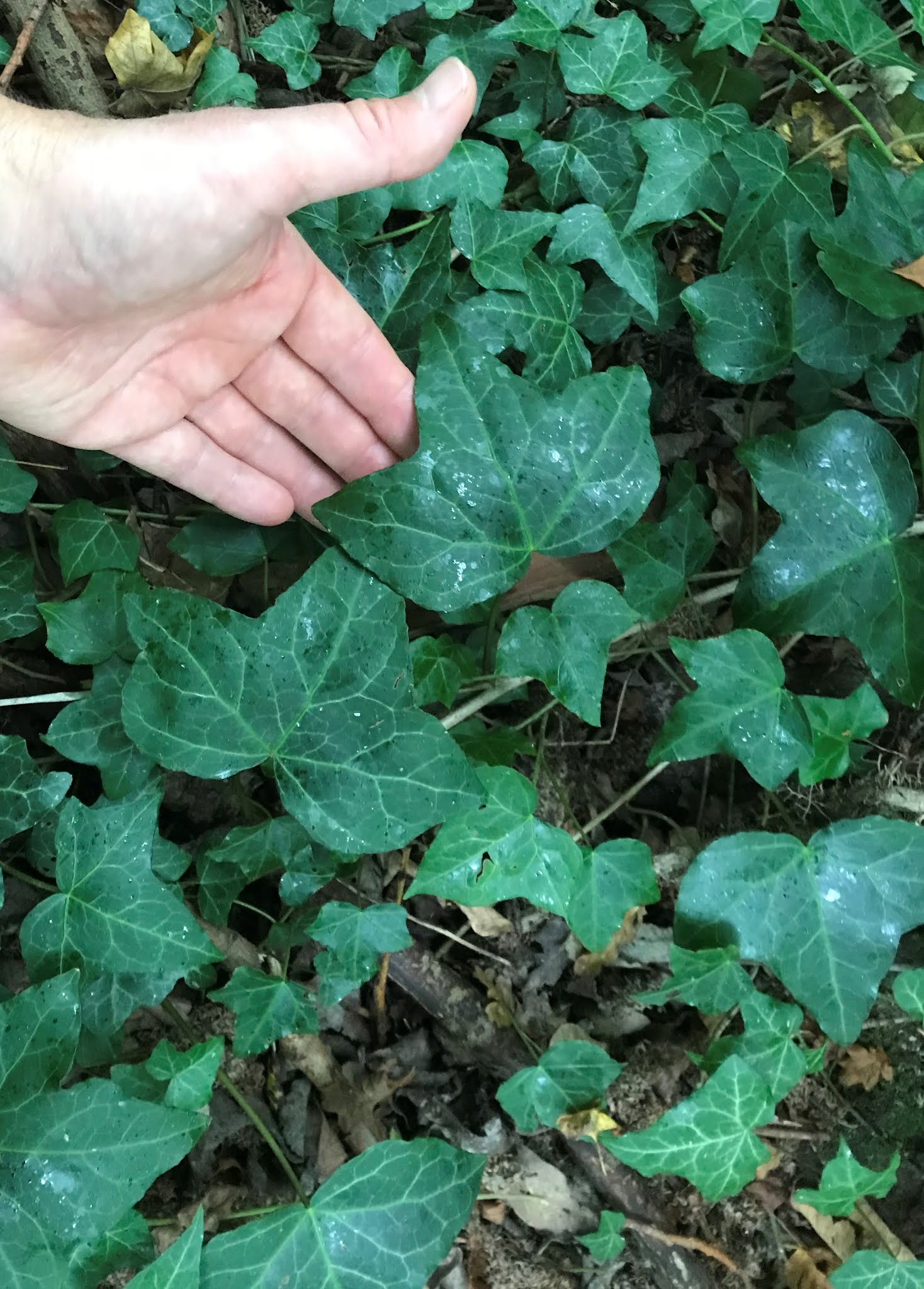
But this is not the only form grown in gardens, and some cultivars are likely to have been grown for as long as 'Hibernica' and therefore are equally likely to have escaped. I was reminded of this recently, when walking through the woodland on the edge of Oulton Park (VC63). My eye was drawn to what at first glance was a carpet of ivy mixed with abundant tree seedlings, but closer inspection showed these 'seedlings' to be part of a very peculiar and heterophyllous ivy. A few young shoots were gathered to look at under the microscope later, and when I did I found the underside of the youngest leaves (the only reliable place to look, and ignoring the leaf margin and major veins) to have a cover of hairs (trichomes) flat to the leaf surface. So, it was a form of Atlantic Ivy, an identification kindly confirmed later by Hugh McAllister, author of the excellent recent monograph on the genus. Hugh also suggested that it looked like the cultivar 'Gavotte', which in itself is interesting as this cultivar is currently considered to be a form of Common Ivy and therefore would need to be reassigned to Atlantic Ivy.


Hedera hibernica cf. 'Gavotte'

This is the third type of Atlantic Ivy I have found in the woodlands around Oulton Park. 'Hibernica' is of course common throughout, but there is another large leaved form which seems to the old cultivar 'Lobatomajor' (and it may sit within a group of cultivars that comprise the Hibernica Group, as the distinguishing distinctively lobed large leaves only start to appear once it starts to climb).

Hedera hibernica 'Lobatomajor'

So inspired by 'Gavotte', and it being a good autumn project now that most plants have gone over for the year, I visited several woodlands in urban fringe locations this weekend to see if I could find more Atlantic Ivy. Something that turned out to be relatively easy, the trick being to focus on those plants with the largest juvenile foliage and/or leaves redolent of 'Hibernica' in shape. None of these plants was as distinctive as the above forms, and instead resemble more typical wild type Atlantic Ivy. But once you get your eye in they do have a distinctive jizz, and the hairs later confirmed these field identifications. It was by no means dominant within the woodlands concerned, but where it has colonised it generally forms dense stands. I'm recording all these finds as neophytes, as I am assuming that they have a garden or other introduced origin. I suspect focussed searching will find them to be relatively frequent in other suburban and urban edge locations.

Hedera hibernica in Hollinhurst Wood, Allerton Bywater (VC64)

Hedera hibernica in Peasecroft Wood, Great Preston (VC64)


Hedera hibernica near Astley Lane, Swillington to Great Preston (VC64)


Sunday, 27 September 2020

Crataegus x rubrinervis

I popped over to Skelton Lake (VC64) today to check up on the bush of Crataegus x rubrinervis (Common Hawthorn C. monogyna x Five-seeded Hawthorn C. pentagyna) I first found in 2018. There are a couple of bushes of Five-seeded Hawthorn a few hundred metres away, and this bush looks like it has arisen in situ.

It has the foliage, large succulent fruit (at their largest they are blackcurrant sized) and suberect sepals (recurving at the tips) of Five-seeded Hawthorn, but with fruit dark red to red-purple rather than purple-black and seeming to ripen later as well. The flesh is reddish coloured, and in this case most of the fruits checked had two pyrenes, but a few had three.


Saturday, 29 September 2018

Black-fruited Hawthorns

I have blogged previously about some of the more unusual hawthorns gradually filling up our countryside, and I always like to keep my eyes open at this time of year for anything that might be different. Some recent finds are still defeating a name.

Last Sunday I was caught a little by surprise when I looked up into a hedgerow near Skelton Lake (VC64) and saw a lot of large black fruit dangling down. These were very succulent, with red-tinged flesh under the skin. Further examination revealed 3 pyrenes per fruit. So instantly my brain was thinking, and regardless of the common name, Five-seeded Hawthorn (Crataegus pentagyna). This species has 3 to 5 pyrenes. This identification was later confirmed at home using a combination of Sell & Murrell and the monograph by Christensen. If I'm honest the latter seems to be a little more user-friendly, and perhaps more representative of the variation present in this genus of notoriously variable species. But both are useful, and its nice to be able to compare and contrast.


Further on I found another bush with comparable fruit but very different foliage. I initially thought it was a hybrid, but it just seems to be a variant of the species (most hawthorn species being highly variable).


Tuesday, 18 September 2018

Chenopodium rubrum var. pseudobotryoides

It really has been an exceptional year for investigating the drawdown zones of my local lakes (Skelton and St Aidan's, VC64) in south Leeds. Even now, at mid-September, they have been continuing to throw interest with the best numbers for several years of Golden Dock (Rumex maritimus) and Nodding Bur-marigold (Bidens cernua).

The latest surprise, as of last weekend, was the abundance of the dwarf decumbent form of Red Goosefoot (Chenopodium rubrum var. pseudobotryoides) at St Aidan's. September really is its season. I've blogged about this plant before when I found it at Eccup Reservoir, and this is the first time I have seen it since then. I believe this may be its first appearance at St Aidan's, certainly I have not noticed it in previous years.


While the evidence is slim there does seem be some indication that this variety has a genetic basis, and that it is not just a response to environment and season. Certainly it is hard to believe it could suddenly turn into the typical plant. I think points in its favour are that when it occurs it does so with great uniformity and often in its 100's, and it coexists with late germinating plants of the typical form which are very small but otherwise perfectly typical.


The stem is characteristically a vivid red, but the leaves are not always this yellow, I think these plants have either been hit by recent cool nights or are running to seed. Given it leaves it so late into the season to appear, it probably lives fast and dies young.


Finally, I can't really mention Golden Dock without including a photograph. So ...


Sunday, 12 August 2018

The Draw of Drawdown

Mike Wilcox sent me interesting news this week that left with me with mixed feelings. He had popped over to Skelton Lake, part of my local patch, and found Mudwort (Limosella aquatica) - a cracking find and the first for the Aire Valley (at least in living memory if not all time). I was pleased because I had been expecting and hoping that this species would turn up, tempered by annoyance that if my weekend walk had taken a slightly different route then I would have got it first!

So naturally I went for a look this weekend and to take a few pictures. In so doing, I was able to extend it even further into the VC64 part of the lake.


Mudwort habitat

This really has been an exceptional year at this site, with water levels dropping consistently over the summer. In recent years rain in summer has re-filled the lake, putting an end to the drawdown season before it had fully got going. The Mudwort has joined the other recent cracking finds of Grass-poly (Lythrum hyssopifolium) and Golden Dock (Rumex maritimus).

A range of other species were putting on a good show. Including this really robust Persicaria. I really wanted this to be something different, it is so striking with its spotted robust stem, distinct nodes, multiple stems arising straight from the root stock and decumbent at the base, and sub-glabrous leaves. But I had to face facts, it was just a form of "Pink" Persicaria (Persicaria lapathifolium subsp. lapathifolium - in my view the circumscription of this in Flora Nordica seems more usable than the more recent one in Sell & Murrell, which under-describes the diversity of the two subspecies). Normally a plant this distinct and forming a distinct population would merit a name (of whatever rank), but the trouble with the Persicaria's is that they are autogamous, throwing up new variants which then breed true. Perhaps if its more widespread ... let me know if you've seen it elsewhere.


It was also nice to see the "Intermediate" Plantain (Plantago major subsp. intermedia), making its 2018 appearance on the strandline.


Unexpected, and again first seen by Mike, was this sunflower (Helianthus annuus).


All this, without mentioning the knotgrasses. That's a subject for another day, but as a taster, Polygonum microspermum. A delightfully dinky species with blue-tinged foliage and tiny flowers. Seems quite a reasonable split to me, especially when seen growing in the 100's.


Sunday, 22 October 2017

Water Bent - Over Looked and Under Recorded?

There are very few records of Water Bent (Polypogon viridis) for VC64. Indeed until last week, just three, all by me, and all from the Leeds area. The first record was from a garden centre in Yeadon, but I have since found two new locations in Leeds City Centre. Mike Wilcox has now added a forth record, for Horsforth approximately halfway between Leeds and Yeadon.

I suspect there will be more records to be made in Leeds. Now onwards is a good time to look as in urban areas it keeps flowering all winter, and therefore it stands out without other grasses to distract attention.

Photo by Mike below showing typical habitat. I would be pleased to have more records.

Friday, 18 August 2017

The 'Grey Man' of the British Flora

The 'grey man' concept is about surviving by never drawing attention to yourself, blending into the background, giving no lasting impression. Sea Pearlwort (Sagina maritima) has this down to a T. Poor thing.

Photo by Geoffrey Hall, NatureSpot website for Leicestershire & Rutland

I suspect I have been overlooking this annual species, and I suspect this will be case for many others also. Particularly those like me who largely botanise inland and therefore do not have this species on their radar as a possibility. Mike Wilcox has recently drawn my attention to the presence of this species at St Aidan's (VC64), and having been for a look I had seen it previously and just ignored it as seedling Procumbent Pearlwort (Sagina procumbens). How wrong I was. After this I found it in pavement cracks in Leeds (VC63). Mike knows this species well from Bradford, about as far from the sea as you can get.

Photo by David Nicholls, NatureSpot website for Leicestershire & Rutland

Part of the problem is that this species is very variable, and many populations comprise tiny plants (2 pence coin size), so it is easily missed. Published descriptions are also not adequate, for example in Stace it is described as 'diffusely branched +/- erect annual'. Not strongly prostrate as per my plants and the photos above. The associated key also links the species to other annual species, the unintended mental image of which (coupled with the description) is a plant similar in character to these other species. The key jizz of the plant as shown above is a central rosette with flowering branches arising around its margins, and no sterile shoots (unlike the perennial species).

I was please to have opportunity again to use my bargain £10 macrolens for my iPhone. Quite pleased with the result below.


Saturday, 24 June 2017

Teeny Tiny Things

Back to Skelton Lake (VC63 and 64) where the drawdown flora is just starting to develop. Much of the strandline has been exposed for a while and is very dry, so we will either need some rain or further drawdown to wet mud if the site is to live up to its potential.

Much of the flora was miniscule. However, it was a great opportunity to test my new toy, a x10 macro lens you can just clip onto a smart phone. Did a good job and a bargain at £10 from Amazon. I will have to see if there is a lower magnification version, as with x10 you are nearly on top of the subject before it comes into focus. Fine for plants, but critters are likely to be less obliging.

Anyway the results below. Best find was Sand Spurrey (Spergularia rubra), hiding amongst the Buttonweed (Cotula coronopifolia) which was also very small but towered over these plants. Also present was Pink Water-speedwell (Veronica catenata) and Swinecress (Lepidium coronopus). In sequence below.